

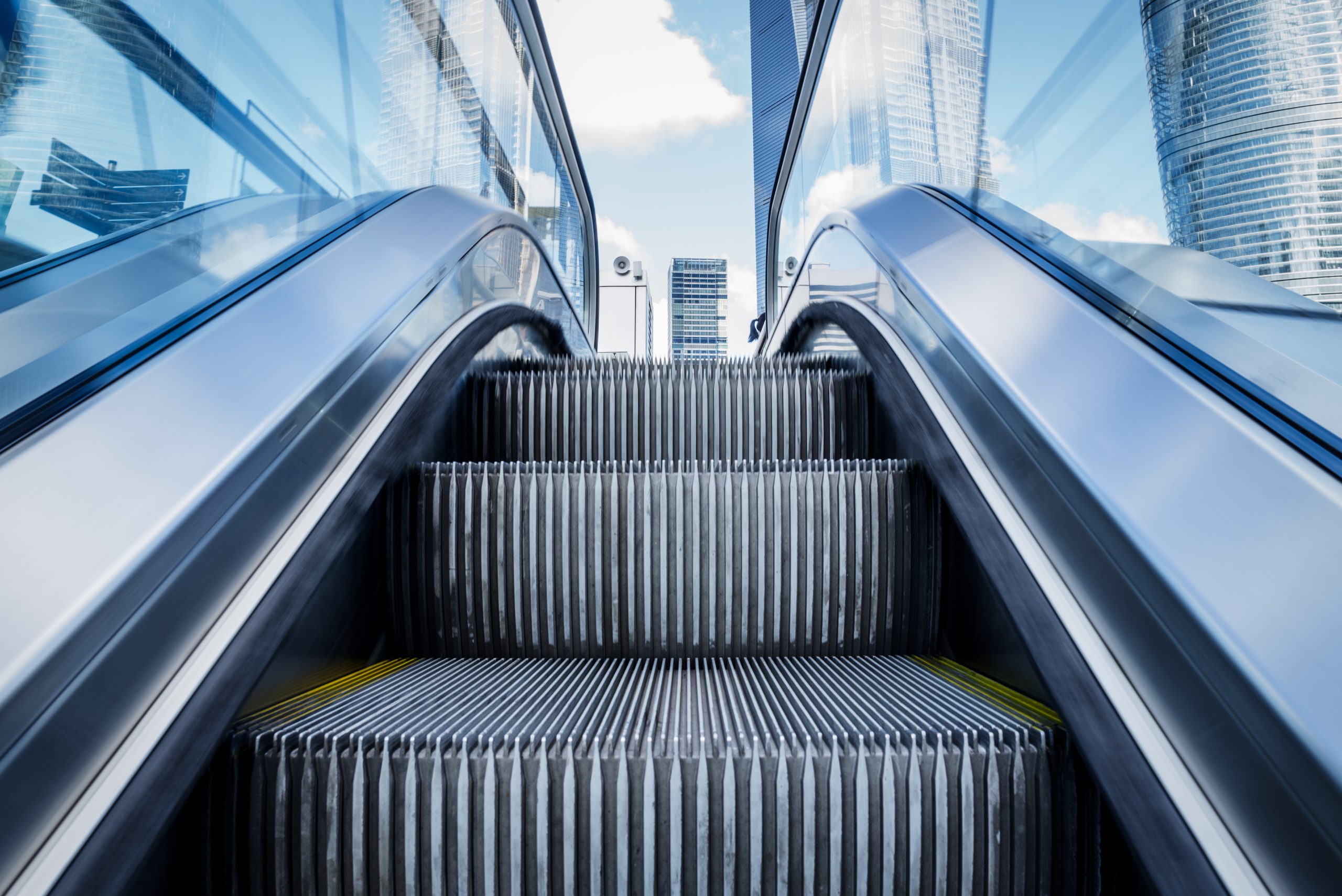

As the ambitious construction rises in Qatar, the demand for vertical mobility solutions is also rising. Now more intelligent escalators are needed in the expansion of international airports, the scaling of global logistics hubs, and the rising of new shopping malls and commercial towers. But how can we choose the perfect specifications of escalators with these various needs in each facility while ensuring safety, efficiency, and uninterrupted flow of users? Here’s a brief guide.
First, Let’s Understand More about Escalator Classifications
Not all escalators are created equally. Their design, components, and durability are related to the intended use and the expected traffic. Misapplying an escalator type is an open door for frequent breakdowns, safety risks, and inflated lifecycle costs.
How Are Escalators Commonly Classified? By Duty and Traffic Volume
This is a main standard for escalators, directly tied to where and how intensively the escalator will be used, so add this standard as a priority in your purchasing decision. Basically, escalators are categorized into 3 types:
- Heavy-Duty Escalators: basically means heavy traffic, but also reflects heavy climate, heavy industries, heavy seasons, and heavy locations.
- Heavy Volume: Just like in major shopping malls (e.g., Mall of Qatar, Doha Festival City). Consistently high footfall, especially on weekends and evenings, which creates a constant need for heavy-duty escalators with the highest safety standards.
- Heavy Climate: Although Qatar is considered a small country, heavy duty here isn’t exclusively about the number of daily users; it’s also about one of the most challenging climates on Earth. In Qatar, the summer temperatures usually exceed 45°C (113°F) with extreme humidity from the Gulf.
- Heavy Industries: In some industries like Liquefied Natural Gas (LNG), Qatar is also the largest world exporter, demanding heavy-duty escalators for heavy use in LNG trains and liquefaction plants.
- Heavy Seasons: Qatar hosts events like the FIFA World Cup and Formula 1. A blackout or system failure during a global event may cause a major safety risk to users and lead to a reputational disaster. This is also the reason why heavy-duty smart escalators are demanded with uncompromising quality and Class A safety standards.
- Heavy Transit Locations: Escalators engineered for 20+ hours of near-continuous operation with peak load conditions. They feature robust drive systems, high-grade step chains, and components designed to withstand the relentless pace of places like metro stations (e.g., Al Aziziyah Station), major airport terminals, and central bus stations.
- Commercial / Standard-Duty: Designed for high-frequency use in retail, offices, and hotels, typically operating 12-16 hours daily. While durable, they balance performance with design flexibility to complement interior aesthetics, commonly seen in venues like shopping malls across Doha. They handle significant traffic but with more pronounced peak and off-peak cycles.
- Light-Duty / Basic: Best for lower-traffic areas such as small offices, residential complexes, or institutional settings with non-regular use. This type of escalator is a cost effective solution where no heavy flow is expected.
Second, Let’s Dig Deep into 5 Key Steps to Specify the Right Escalator
Selecting an escalator depends on several factors, but here is a systematic approach to ensure that specifications are aligned with your project needs.
Step 1: First, Analyze Your Building Traffic
This is a major step, and it should be taken upon facts and data only, no assumptions allowed:
- Analyze Quantify Peaks: The number of Persons-Per-Hour (PPH) rate during rush hours in the morning, in the evening, when people leave, and when a flight arrives. With this number you can calculate 2 things:
- The required speed for the escalator you should purchase (typically 0.5 m/s or 0.65 m/s).
- And the step width (800mm for standard, 1000mm for high capacity).
This is Nominal PPH Formula
Nominal PPH=k×Step Speed (m/min)×Conversion Factor (60)Nominal PPH equals k cross Step Speed (m/min) cross Conversion Factor (60)
Nominal PPH=𝑘×Step Speed (m/min)×Conversion Factor (60)
- PPH = Persons Per Hour
- k = Number of passengers per step, determined by step width:
- k=1.0k equals 1.0
- 𝑘=1.0 for a 600 mm (approx. 24 in) wide step
- k=1.5k equals 1.5
- 𝑘=1.5 for an 800 mm (approx. 32 in) wide step
- k=2.0k equals 2.0
- 𝑘=2.0 for a 1000 mm (approx. 40 in) wide step
- Step Speed = Typically between 30 m/min and 45 m/min (0.5 m/s to 0.75 m/s).
- Conversion Factor (60) = Converts passengers per minute to passengers per hour.
For example, the nominal capacity of a standard 1000 mm wide escalator running at 0.5 m/s (30 m/min) is approximately 6,000 PPH (2.0×30×602.0 cross 30 cross 602.0×30×60).
- Flow Patterns: For example, in a metro station, the flow is usually bidirectional and rushed with the train arrivals. But for a mall, it may be more dispersed but more sustained. You can use simulation software to understand the bottlenecks in your facilities. And this analysis will not only give you the number of users but also the placement and direction of escalator banks that the flow demands.
Building traffic is a main piece of information you should provide the escalators supplier with; you can also choose a partner that has experts to do these calculations with your guide.
Step 2: Define the Level of Compliance an Operating Escalator May Face
The “where” determines the “what.”
- Indoor vs. Outdoor: Especially in the harsh climate of Qatar, indoor escalators, where there will be airconditioned operating environments, closed windows (away-from-dust and outdoor circumstances), and less probability for heavy carriage, are way different from outdoor ones. As stated, environmental specifications are paramount for outdoor or semi-outdoor installations in Qatar.
- Architectural Integration: Also take into consideration the finishing options (such as glass balustrades, customized cladding, and lighting) to ensure the escalator enhances the architectural vision of your constructions.
Step 3: Prioritize Safety Features and Technology
In the past few years, revolutionary developments have been made to increase safety in escalators; it’s now hard to detect escalators that catch objects like skirts, for example; most escalators are developed to have object sensors. Decision makers could take into their considerations more safety features, such as
- Step-Level Monitors & Skirt Sensors: Which automatically stop the escalator when they detect objects caught inside gaps or misaligned steps.
- Handrail Speed Synchronization Sensors: For ensuring that the handrail is moving at the exact same speed as the steps to keep passengers balanced.
- Comb Plate Impact Switches: Which stop operating when there’s something blocking the way at the entry or exit points.
- Safety Brush Borders: Act as a physical and visual barrier to keep users feet away from dangerous gaps in the escalator.
- Clear Safety Signage: Instructional signage, as emphasized by OEMs like Otis, is a primary layer of risk prevention, guiding proper user behavior.
Step 4: Evaluate Total Cost of Ownership (TCO) and Service
The purchase price is only the initial investment you’re making, but the strategic focus should be on TCO.
- Energy Consumption: Choose escalators models with high-efficiency motors and energy-saving modes; they allow effective energy consumption for the 24/7 operating escalators, which leads to huge cost savings in the long term.
It’s important to know that, as per regulations, thorough annual inspections and records are mandatory.
Step 5: Select the Right Partner (Provider/Vendor)
You are not just buying escalators; you are probably entering a 15-20 year partnership.
- Choose a partner with a credible proven track record inside Qatar, it’s better than choosing a partner from outside Qatar, who might not be fully aware of the environment escalators will work through.
- Choose a partner with strong annual inspections, maintenance and technicians.
- Choose a partner with instant responses, and qualified technical support.
- It’s also better to choose a partner who already supplied escalators for facilities in the same industry. This is a strong testament to their capability.
Choosing the right escalator is a strategic decision that extends far beyond basic functionality. In Qatar’s ambitious landscape, where the scale of development, demanding climate, and global visibility set exceptional standards, selecting the right technology and the right partner becomes on the top of priorities list.
