

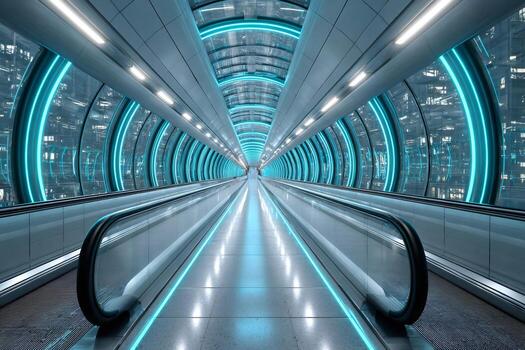

Moving walkways are core solutions for eliminating bottlenecks in critical transit areas like airports. This is also the reason why they’re called Travelators. As we look to 2025, key questions for planners include: What is the investment range for a moving walkway? And what types are available to meet specific project needs? Let’s explore the details.
What is a moving walkway called?
This is a good question to know the best terms for searching. Most commonly, the terms “moving walkway” and “moving sidewalk” are used in everyday language. However, the formal industry term is a “passenger conveyor” or “autowalk.”
In some regions, you might also hear the trademarked name “Travelator” (a portmanteau of “travel” and “escalator”), often used generically. Unlike an escalator, which has steps, a standard moving walkway has a flat, metal or rubber surface that remains level, making it ideal for wheeled luggage, carts, and strollers. Also a variation is an “inclined moving walkway,” that functions like a step-less escalator for more gentle slopes.
How much do moving walkways cost?
In 2025, a single moving walkway unit can range from $100,000 to over $500,000 USD. However, the final price is heavily influenced by three primary factors:
- The Walkway Length: The longer the moving walkway the higher the installation costs, a walkway in a mall, not like a one in the airport. More material used, and stronger motors needed.
- Walkway Width: A wider moving walkway increases passenger density per meter and overall load capacity. This necessitates a more robust structure, a higher-powered drive system, and enhanced safety mechanisms.
- Incline: An inclined walkway involves greater structural complexity than a flat one. This design demands supplementary safety protocols and a significantly more powerful drive system.
- Speed: The standard speed of a moving walkway ranges from 0.5 to 0.65 m/s. Higher-speed models require stronger features.
- Customization & Aesthetics: Some clients request for branding elements, high finishing, custom lighting, or glass balustrades.
- Speed: Standard moving walkways operate between 0.5 and 0.65 m/s. Models designed for higher speeds necessitate a more durable drive system and reinforced safety components.
- Customization & Aesthetics: Clients often request some integrated branding elements, premium finishes, custom lighting, or glass balustrades.
- Maintenance Agreement: Installing a moving walkway comes in parallel with choosing a reliable partner and supplier, who will consequently provide you with a contract that outlines scheduled maintenance, spare parts inventory, technical support, and emergency procedures. While that contributes to the long-term operational costs, it is a vital investment in the sustained performance of a moving walkway.
How does a moving walkway work?
The principle is simple, a moving walkway is like a conveyor belt designed for people. And here’s a breakdown of its components and how it operates:
- A drive system, which is typically an electric motor installed at one of the walkway ends, for driving the gear or the pulley.
- A moving surface, which is the moving surface (the treadway on which passengers stand) consists of a continuous loop, most commonly formed from either interlocking metal plates or a series of durable rubber slats.
- A tractive mechanism, a motor that pulls heavy duty chains or rubber belts attached to the pallets, moving them along a precise track.
- A handrail, which moves at the exact same speed of the walking surface, in order to keep passengers balanced, safe and stable. A synchronized rubber handrail has its own separate drive system linked to the main controller.
- Control systems and safety features: A central microprocessor controls acceleration, deceleration, and speed. Key safety features include:
- Combs: At entry and exit points, these mesh with grooves in the pallets to prevent shoes or items from getting caught.
- Emergency Stop Buttons: Located at both ends.
- Skirt Brush Sensors: Stiff brushes along the sides that, when deformed, can trigger a slowdown or stop.
- Zero-Speed Monitoring: If the walkway slows unexpectedly, brakes engage automatically.
Who makes moving walkways?
Markets of high cost products, with critical safety features, and particularly related to public transit are limited with leading brands that are renowned for their stringent standards. This is the reason why brands that manufacture elevators, escalators, and moving walkways are so prominently identified. Let’s introduce them for you:
- Otis Worldwide: One of the largest manufacturers for elevators, escalators, and moving walkways. Became an independent public company in 2020, installing and maintaining a massive number mobility solutions worldwide, and currently focusing on urban growth, digitalization, and smart, sustainable solutions.
- Schindler Group: Founded in 1874, and renowned for its reliability, Schindler is a leading global Swiss company that manufactures, installs, maintains, and upgrades a wide range of moving walks, including energy-efficient models integrated with the Schindler Ahead™ IoT platform for predictive maintenance.
- TK Elevator (formerly ThyssenKrupp Elevator): A global leader in urban mobility, providing engineering, installation, modernization, and maintenance for elevators, escalators, and moving walks.
- KONE Corporation: A global leader in the elevator and escalator industry, providing equipment and services like elevators, escalators, automatic doors, and maintenance for new and existing buildings to improve “People Flow®” in urban environments. Headquartered in Helsinki, Finland, and operating in over 60 countries.
- Mitsubishi Electric: A key player, especially in Asia, known for advanced technology, high-speed models, and exceptional quietness in their moving walk systems.
Conclusion
Interrupted pedestrian flow doesn’t only frustrate people, it directly chokes the sales funnel, disrupts the operation process, and delays checkins. In critical areas like airports, retail centers, and transit hubs, investing in moving walkways is a key strategic solution for seamless mobility. However, successful implementation demands careful consideration of several factors: technical specifications, long-term costs, trusted manufacturers, and a reliable supplier committed to a lasting partnership.
Sourcing the world’s most trusted manufacturers, IET Solutions is the right direction for installing, maintaining, and upgrading moving walkways, elevators, and escalators all across Qatar.
Ensure your project benefits from reliability, efficiency, and flawless integration, and contact IET Solutions today for a comprehensive mobility consultation.
